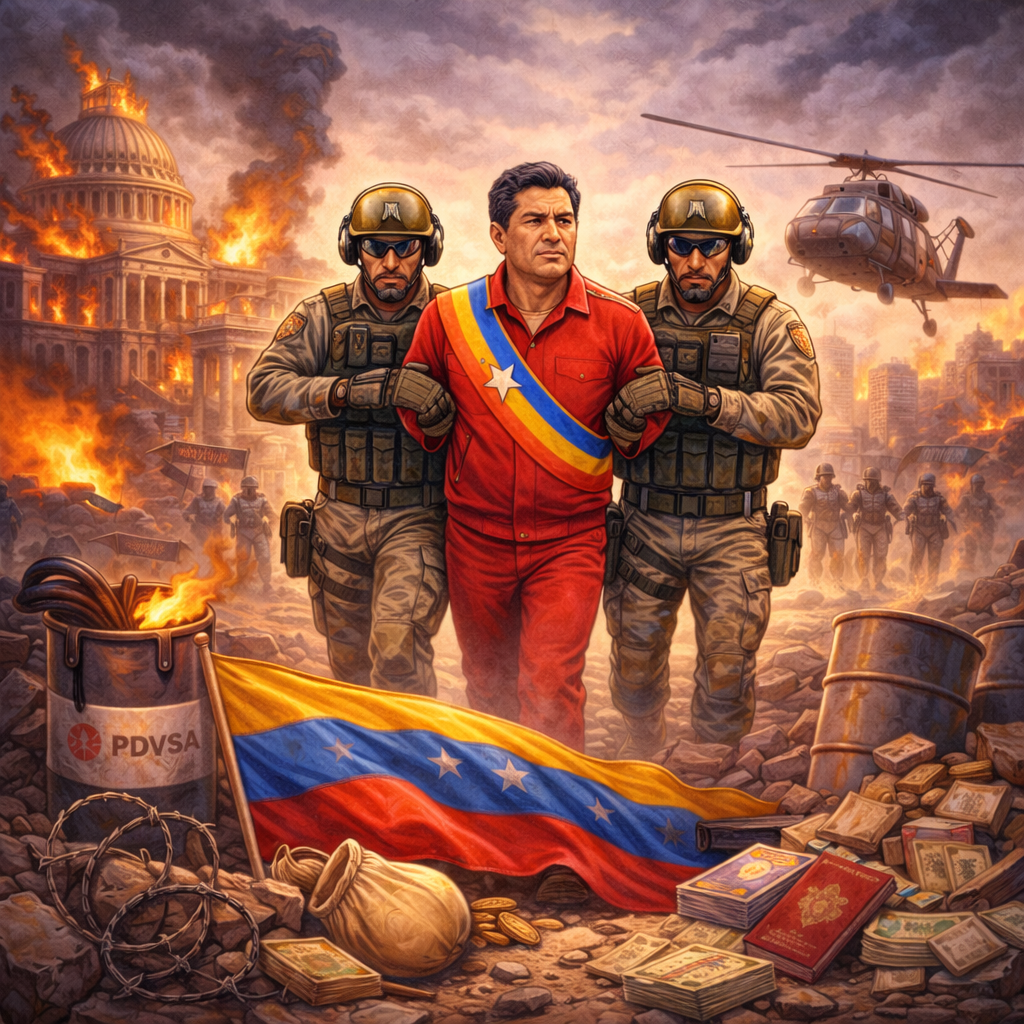
In the wee hours (Venezuelan Standard Time) of January 3, 2026, the geopolitical map of the Western Hemisphere shifted dramatically. Operation Absolute Resolve, a U.S. military intervention, targeted Venezuelan military installations as forces moved to capture the presidential compound in Caracas. The operation resulted in the capture of Venezuelan President Nicolás Maduro and his wife, Cilia Flores, who were flown to the United States to face narcoterrorism, drug-trafficking, and other criminal charges. Maduro is currently in U.S. federal custody in New York, marking the end of a thirteen-year era (from 2013) defined by economic ruin, political confrontation, and international isolation.
What began with the 2014 oil shock evolved into one of the deepest peacetime economic collapses in modern history, leaving roughly 90% of Venezuelans living in poverty and millions forced to migrate abroad.
Following the January 2026 operation and the installation of Vice-President Delcy Rodríguez as acting President, Venezuela now stands at a crossroads: a hollowed-out state attempting to reconcile decades of institutional erosion with the sudden removal of its strongman.
The system under Maduro: From inheritance to economic ruin
To understand the 2026 intervention, one must look back to April 2013, when Nicolás Maduro inherited a rentier state where oil accounted for roughly 95% of export earnings. The global oil price collapse of 2014 triggered a prolonged economic spiral: Venezuela’s GDP contracted by roughly 70-75% between 2013 and 2021, and hyperinflation reached extreme levels, with the IMF estimating annual inflation could approach 1,00,00,000% by the end of 2019.
The resulting economic and humanitarian crisis forced millions to flee, creating one of the largest displacement crises in the Western Hemisphere.
The hardening of power and geopolitical pivot
Venezuela’s economic freefall was cemented by a systemic dismantling of the constitutional order. This began in December 2015 when the opposition Democratic Unity Roundtable (MUD) coalition secured 112 out of 167 seats in the National Assembly, giving it a two-thirds supermajority for the first time since Hugo Chávez came to power. To neutralise this threat, Maduro packed the Supreme Tribunal of Justice (TSJ) with 13 loyalist judges. The TSJ declared the National Assembly in “contempt” after it swore in disputed deputies and ruled that any laws passed by the National Assembly would be invalid.
The institutional coup peaked in 2017, with Sentencias 155 and 156. Sentencias 155 and 156 were two rulings issued by Venezuela’s Supreme Tribunal of Justice in March 2017 that transferred legislative powers from the Opposition-controlled National Assembly to the court, triggering a constitutional crisis. The move was followed by the creation of a pro-government National Constituent Assembly (ANC), which functioned as a parallel authority used to bypass the elected opposition legislature.
As protests and dissent grew, the Maduro government used state security agencies to launch a campaign of door-to-door raids and arrests targeting opposition activists. At the same time, Western sanctions, particularly those imposed by the U.S. Treasury’s Office of Foreign Assets Control (OFAC), froze approximately $7 billion in assets belonging to the state oil company PDVSA and restricted Venezuela’s access to global financial markets. To survive these pressures, Maduro increasingly turned to partners such as Russia, China, and Iran for economic and security support.
Russia provided military equipment and security assistance, including private military contractors who served as advisers to Venezuelan forces. Whereas China provided tens of billions of dollars in loans to Venezuela, which were repaid through long-term shipments of crude oil rather than cash payments. Additionally, Iran helped alleviate Venezuela’s fuel and refinery crisis by sending flotillas of fuel tankers carrying gasoline and refinery feedstock, while also providing technical assistance and materials to help restart facilities such as the Cardón refinery. By 2024, Venezuela had shifted from a fragile democracy into a strategic arena where major powers such as the United States, Russia, China, and Iran competed for influence. This set the stage for the January 2026 kinetic resolution, that is, a conflict being settled through the use of military force.
The legal target: From President to fugitive
Nicolás Maduro’s path to a U.S. federal cell was paved by a March 2020 indictment from the Southern District of New York. The U.S. Department of Justice charged him and other senior officials with narco-terrorism, conspiracy to import cocaine, and weapons offenses. U.S. Prosecutors allege that Maduro led the “Cartel of the Suns,” a state-linked network involved in narcotics trafficking.
By August 2025, U.S. authorities escalated pressure by doubling the reward for information leading to Nicolás Maduro’s arrest to $50 million, the largest bounty ever placed on a foreign head of state. U.S. officials accused Maduro of leading the Cartel of the Suns, portraying the Venezuelan regime as deeply embedded in transnational narcotics trafficking and framing the campaign against him primarily through a law-enforcement and counter-narcotics lens.
Captured on January 3, 2026, Maduro and his wife, Cilia Flores, now face a superseding indictment that U.S. prosecutors say includes alleged links to the Sinaloa Cartel and the Tren de Aragua gang, with U.S. authorities asserting jurisdiction despite the controversial nature of his arrest.
The 2026 ‘Operation Absolute Resolve’
The operation to remove Nicolás Maduro began in the early hours of January 3, 2026. Codenamed Operation Absolute Resolve, the mission utilised a large number of U.S. aircraft and drones to target Venezuelan military installations.
Under the cover of coordinated air operations, helicopters from the 160th Special Operations Aviation Regiment (Night Stalkers) inserted Delta Force operators into Caracas, enabling the ground assault that captured President Nicolás Maduro. The assault team breached the primary residence and detained Maduro and Cilia Flores shortly after entering the compound, as they attempted to reach a reinforced safe room. By early morning, Maduro and Cilia Flores were secured by U.S. forces and transported to the United States. Maduro was subsequently flown to New York, to face a consolidated indictment in the Southern District of New York involving narco-terrorism and a $50 million federal bounty.
Global reactions and geopolitical fallout
The capture of Nicolás Maduro polarised the international community and raised significant legal questions about sovereignty, intervention, and the extraterritorial arrest of a sitting head of state. The United States framed the mission as an effort to enforce narco-terrorism indictments issued by the U.S. District Court for the Southern District of New York against Nicolás Maduro. Russia and China criticised the operation at the United Nations (UN) Security Council, questioning its legality under international law and warning against violations of Venezuelan sovereignty.
Iran warned that the kinetic removal of a sitting head of state would destabilise global norms and criticised the operation. The capture of Nicolás Maduro became a geopolitical flashpoint since it raised serious debates about sovereignty and intervention in the Western Hemisphere.
Lessons for India and the world
Venezuela’s collapse offers a dense blueprint of state failure driven by the resource curse and institutional decay. With oil generating roughly 95% of export earnings and about a quarter of GDP in 2013, the economy lacked the structural diversity to withstand the 2014 oil price crash, after which Venezuela’s GDP contracted drastically.
For India, the Venezuela episode underscores the need for fiscal discipline and economic diversification to avoid the rentier-state trap of excessive dependence on volatile commodity revenues. Venezuela’s political breakdown also demonstrates how institutional erosion can accelerate systemic collapse. It also highlights the critical importance of independent institutions such as an autonomous election authority and judiciary.
At the global level, the January 3rd operation raised profound questions about sovereignty and international law, as a narco-terrorism indictment was used to justify the capture of a sitting head of state. Venezuela’s experience illustrates how prolonged economic collapse and institutional decay can create conditions that may invite external intervention, turning a domestic crisis into a geopolitical flashpoint.
Venezuela at a crossroads
Following the capture of Nicolás Maduro, Venezuela entered a fragile transitional phase rather than an immediate political resolution. Vice-President Delcy Rodríguez was sworn in as acting President to maintain administrative continuity while negotiations over political reform and economic recovery began.
In the weeks following the operation, observers speculated that transitional authorities might pursue political reforms, including prisoner releases, possible amnesty measures, and renewed diplomatic engagement with the United States. Analysts have suggested that reforms to Venezuela’s oil sector, including greater participation by international energy companies, could help revive the industry.
However, the country remains deeply weakened by years of economic collapse, migration, and institutional decay. Its future depends on rebuilding institutions, stabilising the economy, and balancing competing global interests.
Venezuela remains deeply weakened by a decade of economic collapse, mass migration, and institutional erosion. It therefore stands at a crossroads: while opportunities for political reconciliation and economic recovery exist, any lasting transition will require rebuilding democratic institutions, stabilising the economy, and managing the competing interests of major powers involved in the crisis.
Cheers! Catch you later with another interesting and informative episode. Until then...
Disclaimer:This series of articles on Venezuela's long history is intended for informational, educational and analytical purposes only. The historical, political, economic, and social developments discussed, from the country’s coffee and cocoa heritage through the Hugo Chávez and Nicolás Maduro eras, are based on publicly available reporting, expert assessments, and open-source information, including widely reported media coverage and historical sources. The authors and Aionion Capital do not take any position, endorse, or support any political actor, government, or ideology mentioned in the articles. Some details may be subject to differing accounts, incomplete verification, or interpretation, and readers are advised to consult multiple reputable sources when forming conclusions.