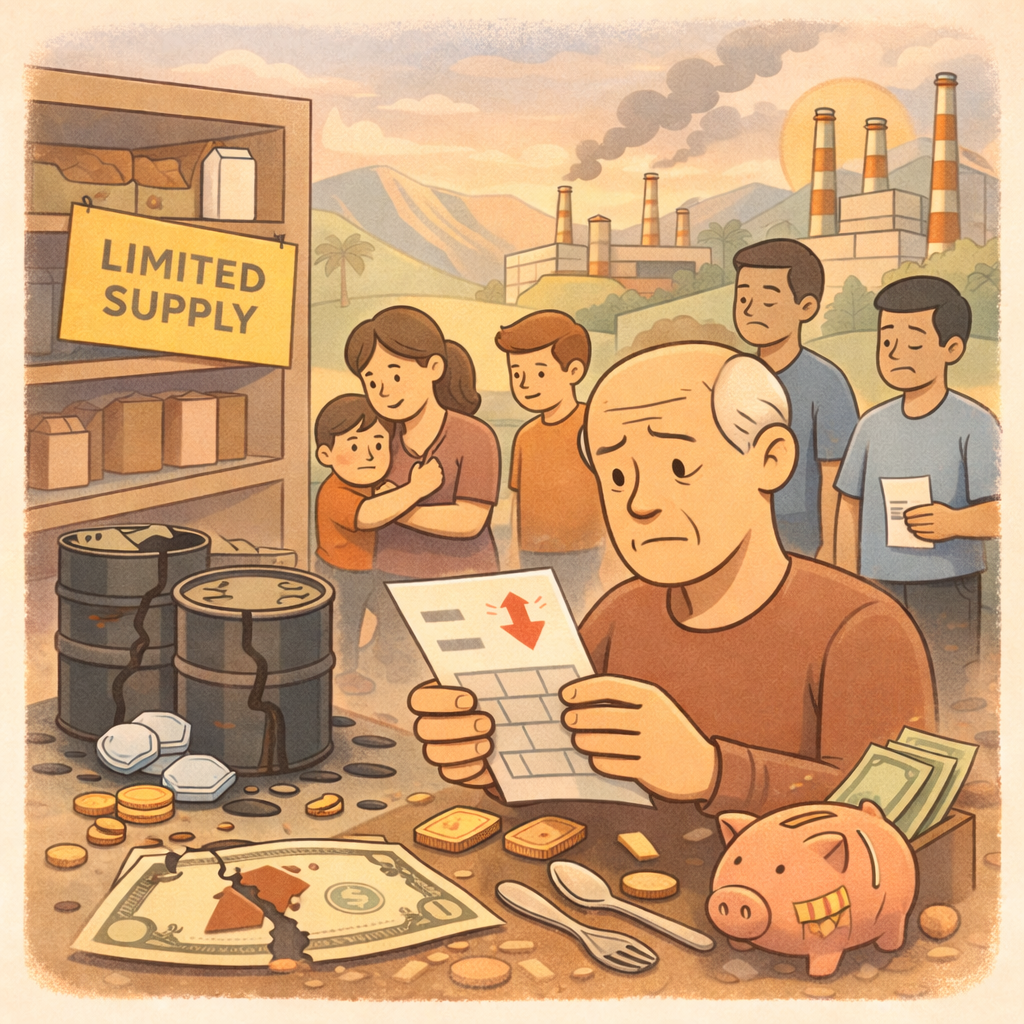
An illusion of wealth without a war
Venezuela's peak of oil-funded prosperity in the 1970s masked a growing vulnerability. Some of the pressures were not so evident at the time; but under the carpet, the ever-increasing debt, increased imports and reliance on oil revenues were narrowing the space that the country could manoeuvre in. It was not a case of a sudden fall, but rather a progressive strain on a system that had been designed with abundance, not versatility or adjustment.
When oil prices stopped doing the heavy lifting
Towards the end of the 1970s, fissures were already beginning to develop under the prosperity provided by oil reserves in Venezuela. With the acute increase in oil prices in the first half of the decade, the world supply started to grow as more countries started producing oil, and consumption in developed economies declined. The prices stopped increasing at the rate that Venezuela had gotten accustomed to. In the years following the domestic oil boom, government expenditure had been rising rapidly, and external debt was growing, with both the state and public enterprises taking loans encouraged by abundant foreign-exchange inflows. A significant portion of export earnings was spent on imports, leaving little room to service debt or accumulate reserves. The economy was still led by oil, but no longer could it be counted on to give the country a smooth ride.
External pressures; bolívar under strain
By the early 1980s, Venezuela's external economic position was showing clear signs of deterioration. As public borrowing in foreign currency increased and foreign-exchange reserves came under strain from persistent import demand, Venezuela's external debt rose sharply by the end of the 1970s. The bolívar (Venezuela's currency) was fixed at a constant rate to keep imports cheap and inflation under control, although defending that rate was becoming increasingly costly for the state. With the loss of confidence, capital outflows increased, especially among businesses and higher-income households that exchanged bolívars for dollars to protect their wealth from an expected devaluation. Instead of structural adjustment, the government responded with short-term damage-control measures, including using up its stock of foreign currency to buy bolívars, pay for imports, and meet debt obligations, in an effort to delay a devaluation. By 1982, it was widely accepted that the existing exchange-rate system could no longer be maintained, making a forced adjustment inevitable.
Viernes Negro (Black Friday): The day the bolívar broke
It was on February 18, 1983, that Venezuela reached the breaking point. For years, the government had been struggling to maintain the bolívar firm, despite the fact that the oil income was decreasing and a ticking time bomb beneath the surface was waiting to explode. In the morning that day, it declared a drastic depreciation of the currency and placed severe restrictions on the availability of foreign exchange, and it suddenly terminated a long-term spell of financial stability. Until that time, the bolívar had been pegged at 4.30 to the U.S. dollar, a rate which enabled Venezuelans to import commodities at low costs and travel abroad at a predictable exchange rate.
The new measures altered the economy by shifting control over foreign currency from the market to the government. The government did not have one exchange rate but instead formed several official rates, and it was up to the state to decide who was to purchase dollars and at what rate. The government now controlled access to foreign currency, requiring approvals for imports, overseas payments, and personal transactions. Many imports were delayed or rationed, foreign payments were restricted, and firms found it increasingly difficult to obtain raw materials from abroad. For ordinary people, the impacts were direct and noticeable: imported food, medicines, appliances, and spare parts became both expensive and inflation accelerated rapidly, and savings in bolívar were sharply eroded within days.
The shock went beyond prices. Over decades, Venezuelans had learned to regard a stable currency as the measure of national power and oil-funded prosperity. The abrupt devaluation destroyed such confidence. The day was dubbed as Viernes Negro (Black Friday), not just due to a technical policy shift, but due to the fact that it was a psychological breaking point, when the truth that oil wealth could bring economic security in people's minds was finally shattered.
Life after Viernes Negro: The 1983 devaluation
In the years following Viernes Negro, the shock turned into a long-term economic squeeze. Continuous devaluations of bolívar, high inflation and stringent exchange controls were gradually draining real incomes especially among the urban middle class that had become accustomed to cheap imports and fixed prices. The wages were not increasing in accordance with the rise in cost, and the shortages began to be more widespread as the companies found it hard to find foreign inputs.
The state budget was put under pressure because the oil income was unstable, and the debt payments took up an increasing proportion of the national income. The governments tried a sequence of adjustment steps in the mid- and late-1980s, which were disproportionately implemented and politically unstable. The illusion that oil wealth would mean social stability had already become conspicuously weakened by the end of the decade, despite the fact that most of the population has increasingly been living in an expensive and insecure daily life.
The Caracazo: When adjustment turned violent
The built-up tension at last burst on February 27, 1989. Just weeks after Carlos Andrés Pérez began his second term, a massive economic adjustments programme, known as El Gran Viraje, was announced by the government, featuring subsidy cuts and a steep rise in the price of fuel. Almost immediately, the transport fares went up, first in the commuter town of Guarenas and gradually across Caracas. What had started as demonstrations against bus fares soon went out of control into massive rioting, looting and confrontations and clashes with security forces.
Within a few days, there was anarchy in most of the capital and its environs and the country went into chaos. The state used military powers to respond to the situation and to restore order, the state brought Plan Ávila to life, a military security intervention that allowed the army to be deployed to Caracas, which resulted in the mass application of violence against civilians. The death toll from the repression was more than 250, although it was later estimated by human rights organizations and subsequent investigations that the number of victims might be in the range of hundreds or even thousands.
The episode, known as the Caracazo, marked a breakthrough. It shattered public faith in the political system established after 1958 under the Puntofijo Pact and exposed the limits of a model that could no longer absorb economic hardship without violence. [Note: Caracazo refers to the large-scale riots and state repression that erupted in Caracas and nearby cities in February 1989. Puntofijo Pact is the power-sharing agreement that had underpinned Venezuela's democracy for three decades.]
The Caracazo did not create Venezuela's crisis; it just revealed it. What collapsed in 1989 was not just an economic programme, but public faith in the system that had governed the country for three decades.
Part-3 shows what emerged from that rupture, and why the old order could not recover.
Cheers! Catch you later with another interesting and informative episode. Until then...