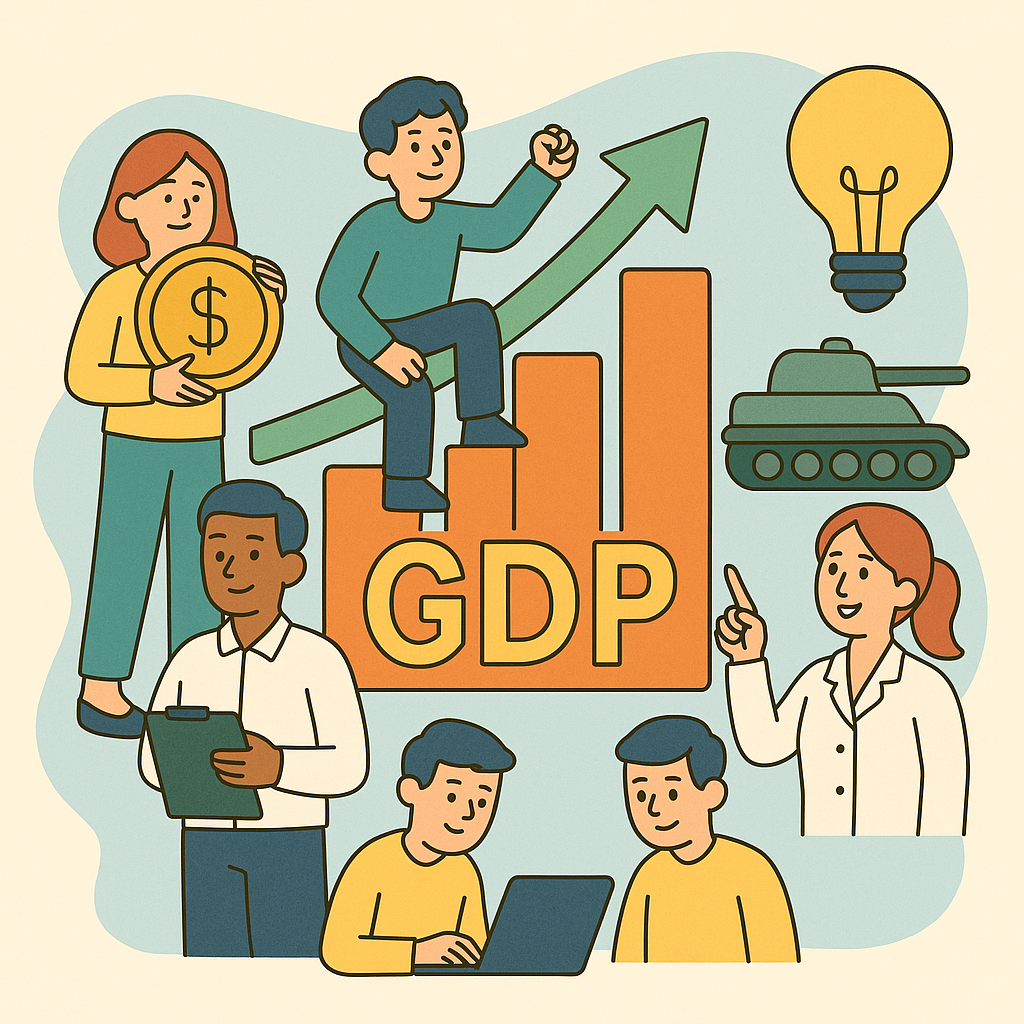
Gross Domestic Product (GDP) is a crucial macroeconomic indicator of the economic health of a country and a rank card for the country's growth and performance. Policymakers, economists, analysts and even investors widely use GDP as a comprehensive metric to evaluate the economic growth of a country, to monitor business cycles and to take informed investment decisions.
The GDP measures the overall monetary value of all the goods and services that are manufactured in a country, only within its borders & boundary, at a given period of time. The GDP also includes defence production/services and also educational services provided by the government.
What's not included in GDP calculation?
It must be noted that not all the productive activity, within the country's boundary, are included in the calculation of GDP. That is, works carried out without payments, say services done at home (due to family love and bonding) any voluntary services, black-market or illegal activities are not included in the GDP. Say, for instance if a mother/wife cooks food for her family, it does not contribute to the GDP. However, the ingredients used for making the food item is added to the GDP. If on the other hand, the same mother/wife is also a chef/hotelier and cooks food for customers, it would be included in the GDP calculation.
Net Domestic Product (NDP)
Further, any "wear and tear" (depreciation) on the machinery, buildings or other capital asset used in producing the goods or services (output) are not included in the GDP calculation. However, the Net Domestic Product (NDP) is calculated after deducting the depreciation amount from the GDP.
GDP doesn't measure standard of living
The GDP is not a tool to measure the overall standard of living of the citizens of a country. The reason being it does not consider how the country's income is distributed among its population. Technically speaking, a country might score an appreciable rank in GDP, yet, it might face unemployment problem. To know the GDP per capita, the total GDP must be divided by the population.
GDP & Recession
A positive GDP growth rate signifies expansion of an economy, while a negative GDP rate indicates contraction. If there is a contraction in the economy, that is negative GDP growth rate, for two consecutive quarters, then the economy is said to be in the phase of recession.
Nominal vs Real GDP
Nominal GDP does not adjust for inflation but instead measures the value of economic output (goods and services) based on the current prices. On the other hand, the Real GDP takes into account the inflation rate of the country, thereby reflecting the actual production volume. To compare economic output, the Real GDP is a better measure since it isolates growth from the price-change effects.
Let's imagine that in India, the nominal GDP increases by 8% in a year, but inflation was 3%, then the real GDP growth would be 5%. Therefore, to identify the real growth and development of an economy and to know if the economy is genuinely expanding, the Central bank and financial analysts focus on the Real GDP.
Limitations of GDP
GDP does not consider income/wealth distribution, inequality of income, unpaid labour (say like the mother/wife cooking for family), voluntary services, informal economic activities etc.
GDP does not have a tool to measure the quality of life or happiness of a citizen of a country. Depletion of natural resources, depreciation, environmental degradation are not included in the GDP.