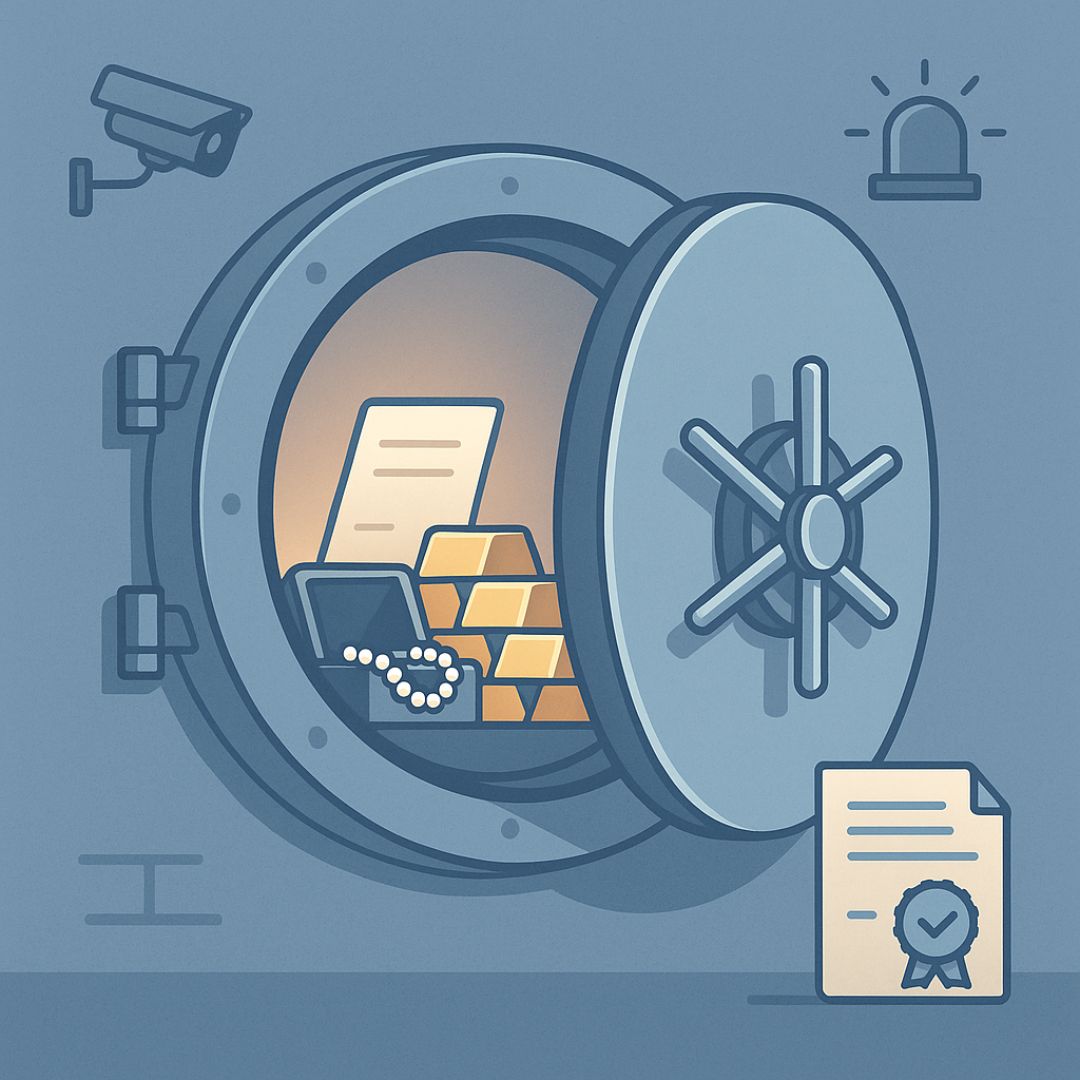
People from various walks of life keep their valuable belongings such as jewellery, gold and silver coins, important documents like house documents or educational certificates in their bank lockers considering the safety and security of such lockers. Compared to individual homes or personal vaults, banks provide highest safety and security with enhanced security measures, 24x7 surveillance cameras, alarms, restricted zones etc to prevent risks of theft or damage arising from fire or other incidents.
The size of the bank lockers ranges from small, medium to large, depending upon the annual rent paid by the customers. Though the bank lockers are spacious enough to hold many things it is important to understand that one must use bank lockers for legitimate purposes only. Membership benefits for availing the bank lockers are subject to certain rules and regulations set by India’s Central Bank the Reserve Bank of India (RBI). Let’s look at what are allowed and what not.
To begin with, the RBI rules have introduced a renewal process of bank-locker agreements. That is, those account holders who have submitted their locker agreements on or before December 31, 2023 must sign a new/revised agreement and shall submit the same to their respective banks before December 31, 2025.
Fortunately, it is the duty of the banks to take necessary measures to facilitate the renewal process such as making arrangement for stamp papers, electronic execution, franking and e-stamping. Further, the bankers have the onus to provide customers a copy of the newly signed/executed agreement copy.
What are allowed and what are not?
As per the new locker rules and regulations, no customer can use the locker for unlawful/illegal purposes. No customer can store any illicit/illegal goods, or any hazardous item. Though the below list might not be exhaustive, you can have a fair idea of what are all allowed and what are not allowed by the bankers for keeping in the lockers.
Allowed: Valuable items such as jewellery, loan/property documents, insurance policies, birth/marriage certificates, savings bonds or other confidential items.
Not Allowed: These items are strictly prohibited from keeping in in bank lockers – cash or any currency, including foreign currency; arms and weapons; drugs and narcotics; any hazardous or illegal items; explosives; contrabands; perishable items, radioactive items. Further, you are not supposed to keep any item that might create nuisance to customers or bank officials.
When are the responsibilities of banks?
Whenever any loss occurred owing to the bank’s shortcomings or owing to an act of commission/omission or negligence by bank staff, it is the responsibility of the banks. Moreover, if there are any fraudulent activity by any of the bank employee, then, in such cases, only banks are responsible.
In above scenarios, the said bank is liable to pay one hundred times (100X) the actual cost of the annual rent of the locker. Say for example, if the rent for a smaller locker is ₹2,000 per annum, then the bank must compensate the customer by paying up to ₹2,00,000. Similarly, if a medium size locker’s rent is ₹3,000, then the locker holder would be compensated ₹3,00,000 and if the rent for a big locker is ₹6,000, the locker holder would receive ₹6,00,000 as compensation from the bank.
In case of theft
For any damage or loss (to the lockers’ contents) incurred by the locker holder owing to the banks’ carelessness, or owing to fire, theft, burglary, or dacoity, the bank is liable to pay the customers one hundred times (100x) the rent of the locker. So, let’s assume that X has availed a smaller size locker and has been paying ₹2,000 rent per annum. Inside the locker, he has kept 25 sovereigns of gold jewellery, 1kg of silver ornaments and other important property documents. Though the value of property kept inside the bank locker runs to several lakhs, Mr. X would get only ₹2,00,000 (100X of locker rent) as compensation. The actual value of the jewellery and other silver ornaments kept inside the locker is immaterial.
In case of death
It must be ensured that customers, while availing the locker facility, also register for the survivorship clause and nomination facility. If the locker holder has signed in for a nomination facility and has nominated a person, then the bank will allow the nominee to access the locker and remove its content after the hirer (locker holder) passes away.
For joint locker operations or joint-hirings, with clear instructions of operation by joint signatures, the nominees will be allowed to operate the locker jointly and contents from the locker can be removed only jointly.
If suppose, the locker holder (hirer) has hired a locker with a survivorship clause and has instructed the bank to allow access to the locker to ‘anyone or survivor’, ‘either or survivor’, ‘former or survivor’ or other survivorship clause, the bank will follow the mandate of one or more in the event of death of the locker holder.
Irony: Appearances are deceptive. Do not judge a book by its cover. We have heard of many adages like these. These adages hold water when it comes to safety and security. That which we think are safe and secure might not be safe and secure, indeed; and that which we think are a threat/danger might not be so in reality. If fact, it might even be a blessing in disguise. We could feel your pulse – bank lockers and stock market.
Cheers! Catch you soon with another interesting and informative episode. Until then…