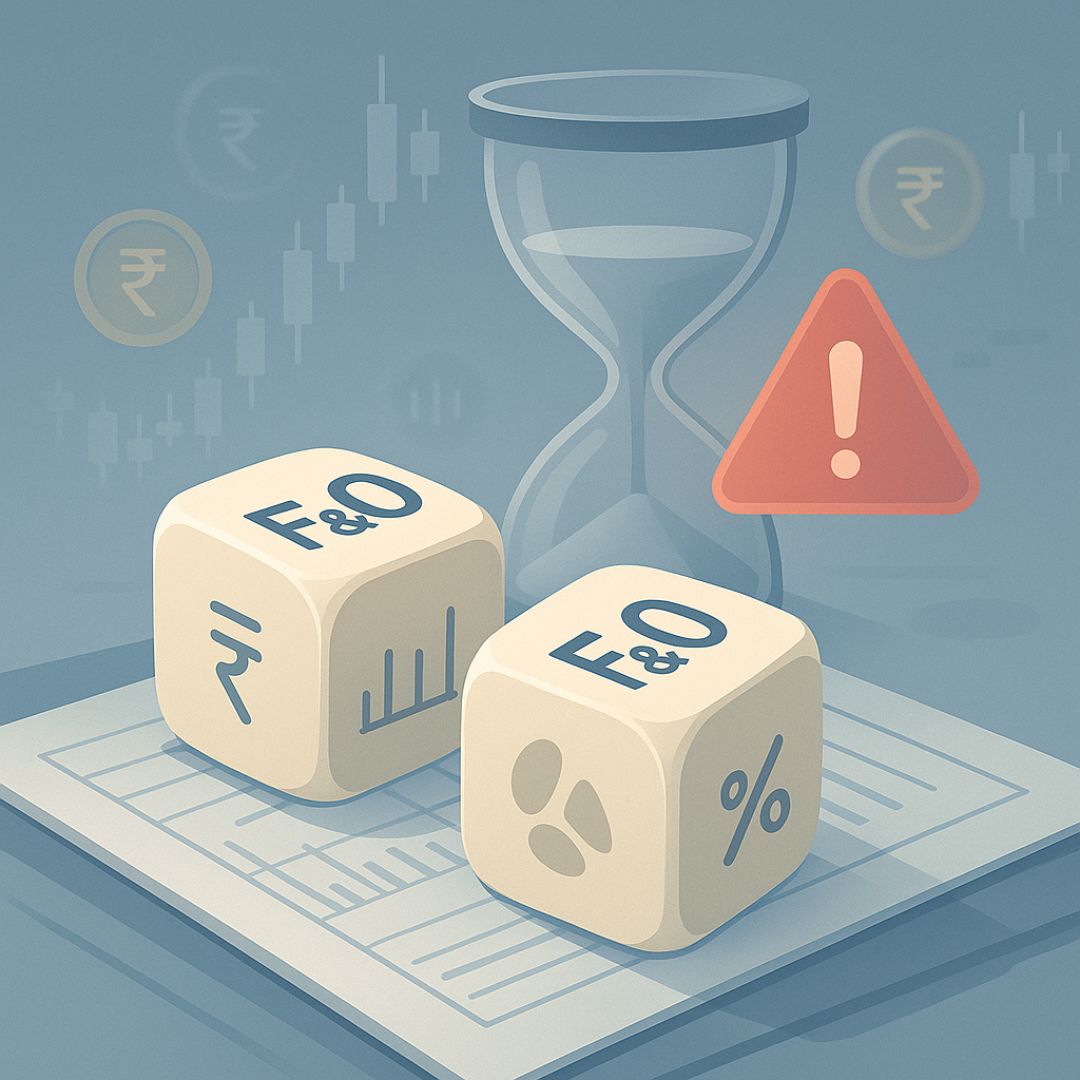
Let’s start from the nuggets of wisdom from experts.
Global warnings:
Warren Buffett (Oracle of Omaha): 2002 annual chairman’s letter of Berkshire Hathaway – “We [here, Mr. Buffett refers to Charlie Munger] view them as time bombs, both for the parties that deal in them and the economic system.”
Further, in the same letter Mr. Buffett said: “In our [with Charlie Munger] view, Derivatives are financial Weapons of Mass Destruction (WMD), carrying dangers that, while now latent, are potentially lethal.”
Mr. Buffett said closing a Derivatives business is easier said than done. He compared Derivatives to the reinsurance business and said, “They are like Hell, both are easy to enter and almost impossible to exit. Once you write a contract, you are usually stuck with it.”
Even after six years of knowledge accumulation and experience, he didn’t change his opinion about Futures & Options and in his 2008 letter he said: “Derivatives are dangerous. They have dramatically increased the leverage and risks in our financial system. They have made it almost impossible for investors to understand and analyse our largest commercial banks and investment banks.”
Once again, opinion not changed after another eight more years of solid knowledge accumulation. In one of the annual meetings in 2016, he said: “The state of the Derivatives market was "still a potential time bomb in the system — where discontinuities can exist, can be real poison in markets.”
In 2018, the Vatican also jumped into the bandwagon and in its Holy See Press Office Bulletin, it said: “Some financial products, among which the so called “Derivatives”, are created for the purpose of guaranteeing an insurance on the inherent risks of certain operations often containing a gamble made on the basis of the presumed value attributed to those risks.” It said that some types of Derivatives transforms into a ticking time bomb ready sooner or later to explode, poisoning the health of the markets.
Warnings from Indian financial experts
In 2023, former Securities and Exchange Board of India (SEBI) chairperson Madhabi Puri Buch said: "I must admit, I am always a little confused and surprised as to why people continue to do that (bet in Futures & Options) knowing that the odds are not in their favour at all. There is a 90% chance that the investor will lose money in the F&O segment.”
Further, Finance Minister Nirmala Sitharaman, NSE chief Ashishkumar Chauhan, Chief Economic Advisor V. Anantha Nageswaran have all warned investors against the potential risk of trading in the Futures & Options segment.
Why are these financial experts terrorising investors to stay away from F&Os. Is F&O trading really a ticking time bomb or a hidden gem or jackpot? Do these experts express real concerns or simply warn us with false threats or dangers just to “gobble up the hidden gems or jackpots” by themselves. Let’s find out…
What is a Derivative?
A Derivative, for example, Futures & Options is a financial contract, and its value is based on the price of an underlying asset. An underlying asset is the base asset on which the value of a Derivative is derived from. The underlying stocks could be individual company stocks, stock indices such as Nifty, Bank Nifty etc, or even commodities such as gold, silver, crude oil, natural gas, etc. If the price of an underlying asset increases, the price of the Derivative also increases, similarly, if the price of the underlying asset decreases, the price of the Derivative also decreases.
Say, for instance, if the rate of gold increases, the rate of gold Futures contract in the Multi Commodity Exchange (MCX) will rise too. If the ITC share price increases in the spot market, ITC Futures and Options price will also increase. Here, gold and the ITC stock are the underlying assets for the gold Futures contract and the ITC Futures & Options contract. In a similar vein, the Nifty 50 is the underlying asset for the Nifty Futures contract. In India, there are two popular forms of Derivatives – Futures and Options (F&Os).
What are Futures & Options?
Both Futures & Options are Derivative financial contracts but with a difference. In a Futures contract, the buyers as well as the sellers have an obligation to buy/sell an underlying asset at a predetermined price (decided today) on a future date. In contrast, in an Options contract, buyers have the right to buy an underlying asset by entering a Call Option, but they do not have an obligation to buy. Likewise, the buyers in an Options contract have the right to sell an underlying asset through the Put option but they do not have an obligation to sell. In both the Options cases (Call & Put), the contracts are agreed upon on a predetermined price for a future expiry period. Thus, as opposed to Futures, Options gives the traders the flexibility of avoiding the obligation and hence, traders/investors believe that Options are comparatively safer.
speculation. If a trader predicts some direction of the market (rise/fall) and if the market goes as per his/her prediction, he/she makes profit, if not, he/she ends up with a huge loss. There is a popular adage in the market parlance: “There are more options if one wants to trade Options; but if you trade in Futures, then you (the trader) have no future.”
It is because of this famous quote, Options traders think that Options are easy and a viable choice to make easy and quick profits. Agreed, there are more options in Options, however, almost all are highly risky, and your capital could be completely erode to zero.
Those who buy Options are in the belief that the maximum loss incurred by them, in the event of wrong prediction about the market direction, would only be to the extent of the premium amount paid. However, this might hold true in theory. Many are ignorant that the premium loses value, minute by minute, owing to the passage of time (Option greek Theta). It might not be exaggerating if I say that the premium amount paid to buy an Option contract is like that of an ice cream. Owing to the time-value decay, the premium price melts every second.
Magnified losses owing to leverage risk
Leverage is one of the deadliest risks of Derivatives. This facility allows traders/investors to buy more lots (units of stocks bought together) or take larger positions with lesser capital. In cash segment or the spot market, if an investor wants to buy 100 stocks, he must first pay the value of all the stocks in full payment and only then he could buy them. The broker will not give margin facility, in most of the cases, for buying stocks on delivery basis. However, in Derivatives market, one can buy more lots, buy paying just the margin money and the remaining amount will be given as loan by the brokerage firm. Greedy traders, to make quick profits, make use of the margin money and buy more lots. So, the loss is also huge and often beyond their reach and control.
Just a simple logic. When profits can be magnified with the help of margin money, losses can also be magnified. There is no harm when the profits are magnified, but a single magnified loss will ruin the entire life’s savings. Even a small negative movement in the price of the Derivative product could cause severe, unbearable and irrecoverable damage to the individual financially and psychologically too.
Derivatives are helpful for hedging
Veteran traders or the so-called informed traders use the Derivative products as a hedging strategy for mitigating losses. Unfortunately, budding traders or the retail investors trade in the Derivatives segment to make quick profits, that too without sufficient skill or expertise in the subject. What these people do is just a speculation, which have the potential to ruin their financial stability completely. Avoid gambling in the Derivatives market as F&O speculations are quite risky.
‘Fake’ assets
When you invest in equity market in the cash segment, that is on delivery basis, you are in fact investing indirectly in the growth and economy of the country, provided you buy good stocks. These delivery-based equity stocks are real financial assets (movable) that will, in the long run, fetch high returns, even beating the inflation rate. However, the F&Os, that is the Derivative products, are not assets at all. However, in the name of diversification, and assuming it to be an asset, people indulge in F&Os. It won’t be exaggerating if I say that gambling in a casino and trading in F&Os are no different. Both fetch profits only to the owners of the casinos and brokerage firms respectively and the losers, in most cases, would be the players. These are not assets because, once the Derivative contract expires, you cannot own/possess them. Therefore, there is no question of growth or returns in the long run.
So, when financial experts caution us against Futures & Options, they have a valid reason. Always be aware that greed brings grief. Derivatives are just like casinos, the Hell, wherein it easy to enter but difficult to exit. As Warren Buffett rightly said, they are ticking time bombs and any time they could explode. Wise people will always prefer the Heaven not the Hell.
Cheers! Catch you later with another interesting and informative episode. Until then...