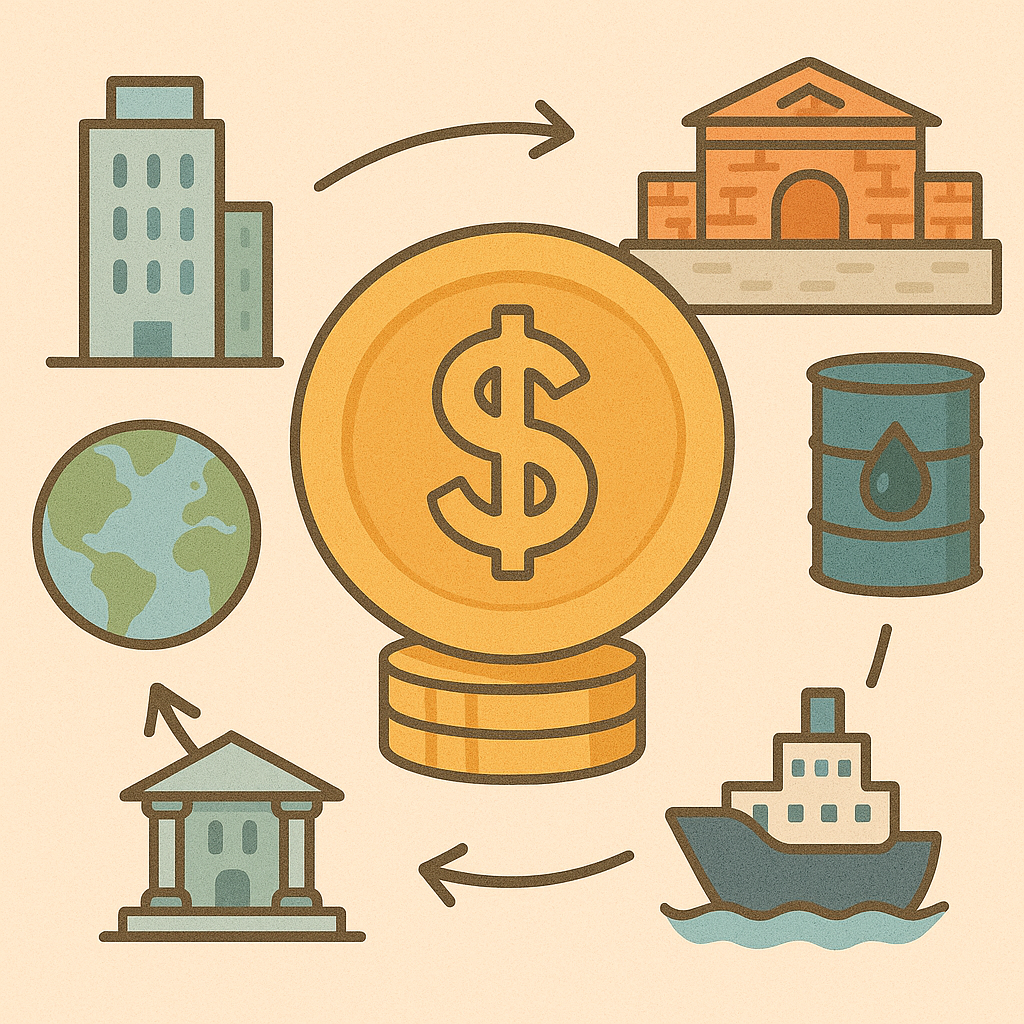
Be it the 2008 financial meltdown, the COVID-19 pandemic or the geopolitical shock of the Russia-Ukraine war, economists and financial experts observe a pattern: investors and even nations turn to the U.S. dollar. The U.S. Treasury bonds attract massive inflows of capital, the dollar strengthens in relation to other currencies. It may be noted that the global commodities, from oil to wheat to gold or silver, are largely priced in dollars. Even though the dollar has not been backed by gold since 1971, it continues to wield unmatched influence across the globe, a paradox of modern finance. How does a fiat currency, just a paper-promised currency, become the world's most trusted asset? Decades of deliberate U.S. policy, global accords, and strategic economic moves have forged the dollar into the world's dominant currency.
Bretton Woods Accord
The United States started emerging as a world's dominant economic power in the aftermath of World War-II and from there the dollar began its ascent as a global currency. In 1944, from July 1 to 22, 44 Allied nations met in Bretton Woods, New Hampshire, to introduce a new global financial system that would prevent the economic instability (of nations) that had contributed to two World Wars.
The Bretton Woods Conference, formally known as the United Nations Monetary and Financial Conference, gave birth to the Bretton Woods Accord. The Bretton Woods agreement established the U.S. dollar as the anchor currency, pegged to gold, while other major currencies were pegged to the dollar. This arrangement placed the world on a limited Gold Standard: the U.S. dollar was the only currency that any foreign government could officially redeem for gold from the U.S. Treasury at a fixed rate of $35 per ounce. This was not like buying gold in the open market but a formal, legal backing given by the United States' massive gold reserves. Most nations trusted the U.S. dollar as the most stable and reliable store of value in the post-war era because other currencies did not provide this backing.
The Bretton Woods Agreement not only stabilised exchange rates but also positioned the Greenback at the centre of global trade and finance. Further, the creation of the International Monetary Fund (IMF) and the World Bank at Bretton Woods, largely shaped by the United States and the United Kingdom, reinforced U.S. influence by channeling reconstruction funds and development assistance through dollar-based mechanisms. Other nations accepted this structure because, in the aftermath of World War II, the U.S. was the only power capable of stabilising the post-war global economy, effectively cementing the Greenback at the centre of international finance.
The Nixon Shock
By the late 1960s, the two-decades of the Vietnam War (1954 to 1975) strained the Bretton Woods system due to growing U.S. fiscal deficits, rising inflation, and the costs of war. Many foreign central banks exchanged their dollar reserves for gold, thereby threatening to deplete U.S. gold stocks held at Fort Knox and other reserves.
In response, on August 15, 1971, President Richard Nixon announced the suspension of dollar convertibility into gold, a move famously known as the Nixon Shock. Nixon's move put an end to the Bretton Woods system and marked the transition to floating exchange rates. In this phase, the value of currencies was determined by market forces rather than a fixed value tied to gold (gold parity). Though this strategy severed the dollar from a tangible backing of gold, it paradoxically did not weaken its dominance in the global arena. Instead, the currency remained the cornerstone of international finance, supported by the U.S.'s economic and political dominance.
The Petrodollar System
The end of the Gold Standard created uncertainty about the dollar's long-term role in the global financial system. Later, in the early 1970s, a strategic partnership with Saudi Arabia and other Organization of the Petroleum Exporting Countries (OPEC) countries created the Petrodollar system, in which oil sales were denominated exclusively in U.S. dollars. In return, the U.S. offered military protection and political support to these nations.
Through this arrangement, the U.S. ensured that the global demand for oil generated steady demand for dollars, thus, reinforcing its dominance in international trade and finance. With oil priced in dollars, the Greenback gained a new pillar of support, ensuring that global demand for energy translated into global demand for U.S. dollars.
Rise of Eurodollar and Offshore Dollar Markets
No doubt, the Petrodollar system strengthened the dominance of the U.S. dollar in the global trading arena. However, silently, yet another powerful wave started sweeping through the international market: the unavoidable rise of the Eurodollar market. For nearly two decades, say from the mid-1950s, banks in London started accepting deposits in the U.S. dollars and in turn used them to issue loans in dollars. This created a parallel dollar-based banking system outside the United States, the one that operated entirely beyond the reach of American rules and regulations.
These Eurodollars were nothing but the U.S. dollars circulating outside American borders, beyond the reach of U.S. banking rules known as Regulation Q. The Rule capped interest rates that U.S. banks could offer for deposits. But, foreign banks in the Euro market offered higher interest rates on dollar deposits, thereby attracting corporations, governments, and investors seeking better returns. On top of it, the U.S. was spending so much dollars overseas, on imports, oil, and other military commitments. Those dollars accumulated in foreign banks, giving them funds to expand the offshore dollar market and London became the hub of this. The rise and acceptance of Eurodollars globally, created a vast pool of offshore liquidity, further cementing the Greenback's central role in world finance.
It wouldn't be an exaggeration to say that by the end of the 1970s, a strong foundation was laid for the dollar's supremacy. What was started merely as a post-war arrangement (Bretton Woods), where other currencies were tied to the dollar, and the dollar itself was anchored to gold, had completely transformed into a vast, multi-layered system. That too, a system which is supported by global institutions, a system that is backed by oil, and a growing offshore banking network that piggybacked on the Greenback.
The yellow metal, lying idly inside the vaults of Fort Knox, no longer influenced the vital role played by the dollar. Its strength now came from the sheer depth of U.S. financial markets, the liquidity of its Treasury bonds, the scale of international trade denominated in dollars, and the confidence nations placed in America's economic and political stability. This architecture made the dollar not just a currency, but the central pillar of the modern global economy.
But wait, the forces that built the dollar's dominance are the story of the past. Geopolitical tensions, financial sanctions, the rise of China, BRICS currencies, and debates on de-dollarization started playing an important role in the next phase of the dollar's journey, which is now influenced more by real-time global events. This is the story of how the dollar rose. What lies ahead for the Greenback in a changing world unfolds in the next part. Until then...