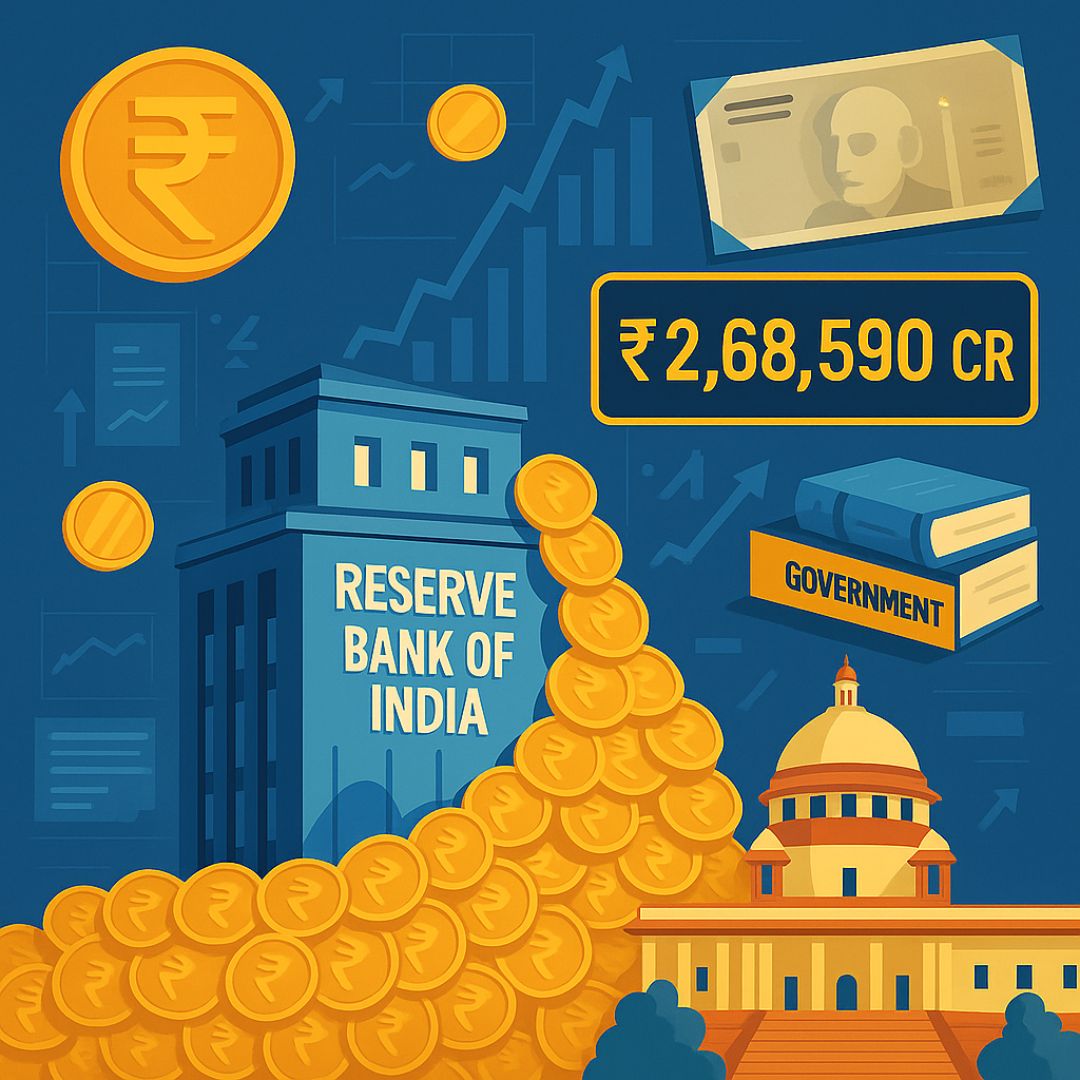
The Reserve Bank of India (RBI) transferred a whopping sum of ₹2,68,590.07 crore as surplus to the Central Government. Last year, it was just ₹2,10,873.99 crore and the rise in the surplus was approximately 27.37% over the previous year. Surplus means the excess of RBI’s income generated over its expenditure incurred during a period, after setting aside funds for contingencies.
Every year, RBI transfers its surplus to the Central Government, which is the owner of the RBI. From the perspective of the Central Government, money received from the RBI is not termed as dividend but simply called as surplus transfers. This is because RBI is not a commercial bank like other government-owned (or controlled) banks or companies that pay dividend to the owner (Central Government) on the profit generated.
How does RBI make profit?
₹2,68,590.07 crore surplus transfer… No doubt, this was a bumper lottery to the Central Government. But ‘WHY’ is the million-dollar question. Some might even be curious to know the source of the funds.
It’s not rocket science. Even a little bit of logical reasoning would help you understand the complicated structure of RBI’s profit-making strategy. Though the Central Bank of the country, RBI is also a bank in the first place. The predominant role of any bank is to lend loans. In a similar fashion, RBI lends money too. Lending and interest charge are Siamese twins that are inseparable. When RBI lends money, it charges interest on the principal, thereby generating income. A portion of this income is categorised as surplus money.
Further, RBI buys and sells Government Securities and bonds. Again, it’s easy-peasy to understand that there will, for sure, be a profit in the business of buying and selling.
SEIGNIORAGE secret
Next, like individuals, even the Central Bank makes investments for generating income. It invests a portion of its money in foreign assets, which generate income too. Moreover, unlike other banks in the country, RBI has an exclusive right to issue currency. Of course, there is no profit in the money-printing business. But wait, before rushing to the conclusion, let’s try to grasp SEIGNIORAGE. The profit is hidden in the difference between the face value of the bill (currency note) and the cost involved in the production of the currency note itself. For instance, say RBI prints a 500-Rupee note, the face value would be ₹500 and the cost of producing the note would be much lesser, say ₹20. Just by printing a ₹500 note, it makes a profit of ₹480. No other banks in the country enjoy this privilege.
Overall, one thing is clear. RBI has umpteen number of ways to make profit and there is no dearth of money in its coffers. Hope, your curiosity on the source of the funds is satisfactorily answered.
Why does the RBI transfer money?
Now, let’s address the even more challenging question. Why is the RBI transferring money to the Central Government? Section 47 of the RBI Act, 1934, mandates that any profits generated by the RBI must be transferred to the Central Government.
In December 2018, the RBI constituted a six-member Committee, headed by former governor Dr. Bimal Jalan to review the current Economic Capital Framework (ECF). This was done after the Ministry of Finance asked the RBI to follow global practices. The calculation of the surplus money is based on the ECF recommended by the Bimal Jalan Committee. The Committee advised the RBI to maintain a Contingent Risk Buffer (CRB) between 5.5% and 6.5% of its balance sheet.
The Committee recommended that the Central Bank must transfer its surplus to the Central Government after maintaining the CRB within the suggested range.
How is the money used by the Central Government?
When the RBI transfers its surplus to the Central Government, it is ideally transferred to the Consolidated Fund of India (CFI), thereby becoming a part of the Government’s general pool of revenue (non-tax). As per RBI Act, 1934, Section 48, RBI is not liable to pay any income tax to the Central Government on any of its income or profits. After making provisions for contingency funds and Asset Development Fund (ADF), the RBI transfers its surplus to the Central Government. The ADF is a reserve maintained by the RBI for meeting capital investments such as building infrastructure, technology upgrades etc.
Once again, you might be curious to know what the Central Government would do with this huge surplus money. The government could use this surplus money in several ways, based on budget priorities and economic context. For instance, the dividend amount could be used for reducing the fiscal deficit of the country; for boosting capital expenditure; can be used for welfare schemes such as Mahatma Gandhi National Rural Employment Guarantee Act (MGNREGA) rural employment schemes; health-care support such as vaccines; educational programmes; repay public debt; provide assistance during pandemic such as COVID-19; or even retain a portion of the surplus as fiscal cushion to meet unforeseen needs.
That said, I hope the money is put to good use. See you guys soon with another interesting episode, don’t be a stranger. Cheers! Catch you later…